Excused or Unexcused? Let the System Decide
Have SYSTEMS to do some of the heavy lifting for you each day.
Being a head coach can absolutely drain your battery. I'm not talking about calling plays, planning practice or watching film. I'm talking about making decisions all day long.
Most people who have never been a head coach don't fully understand this. Being a head coach means solving problems from the time you walk in the door until you leave.
I heard the late, great Bobby Bowden say at a convention once, "If you don't want to solve problems, don't become a head coach."
Bingo.
I can guarantee every coach reading this has dealt with the same two headaches: players being late and players missing practice. A coach needs something. A parent calls. A kid wants you to decide whether his absence should be excused.
Each one takes a little piece of your battery. That's why one of the best things you can do as a head coach is build systems that make decisions for you.
Don't Make a Decision When a System Can Make It for You
Let's take something as simple as a player being late to practice. What happens when he comes jogging onto the field five minutes late?
Do you stop what you're doing and ask where he's been?
Do you decide whether his excuse is good enough and then determine what his punishment should be?
That's a lot of decisions for something that shouldn't require any.
We had a system. We assigned a coach we affectionately called The Grim Reaper.
When They were Late
If you were late, you didn't come find me and you didn't explain yourself to your position coach. Before you could step onto our practice field, you reported to the Grim Reaper and pushed plates across the back of the end zone.
The Grim Reaper kept a notebook and recorded every infraction. Each time you were late, the amount of yardage increased.
If you're thinking, Coach, I can't spare a coach to do that, I'd argue that you can't afford not to. Without a system, you're going to have six coaches handling tardiness six different ways, and eventually every late player becomes the head coach's problem.
That notebook became valuable for another reason. When Mom and Dad wanted to know why Lil Johnny wasn't starting or playing as much as they thought he should be, we didn't have to say, "Well, it seems like he's been late quite a bit."
We had receipts.
Then There Were Absences
For years, we did what I think a lot of staffs do. After practice we'd record who wasn't there, and then the next day we'd listen to their explanation and determine whether the absence was excused or unexcused.
Was his reason legitimate? Was this situation different from the kid last week? Was I being consistent with what I had done before?
It sounds like no big deal until you realize how many of these little decisions a head coach makes every day. Your battery doesn't usually get drained by one huge decision; it gets drained one little judgment call at a time.
Then my friend Rick Jones taught me a better way.
If you don't know Rick, you should. He's currently Assistant to the Head Coach at Mizzou, a nine-time state champion head coach, and has forgotten more about football and running a program than I'll ever know.
We became friends more than a decade ago, and that friendship has been a tremendous blessing to me. One of the many things Rick taught me was a system he calls:
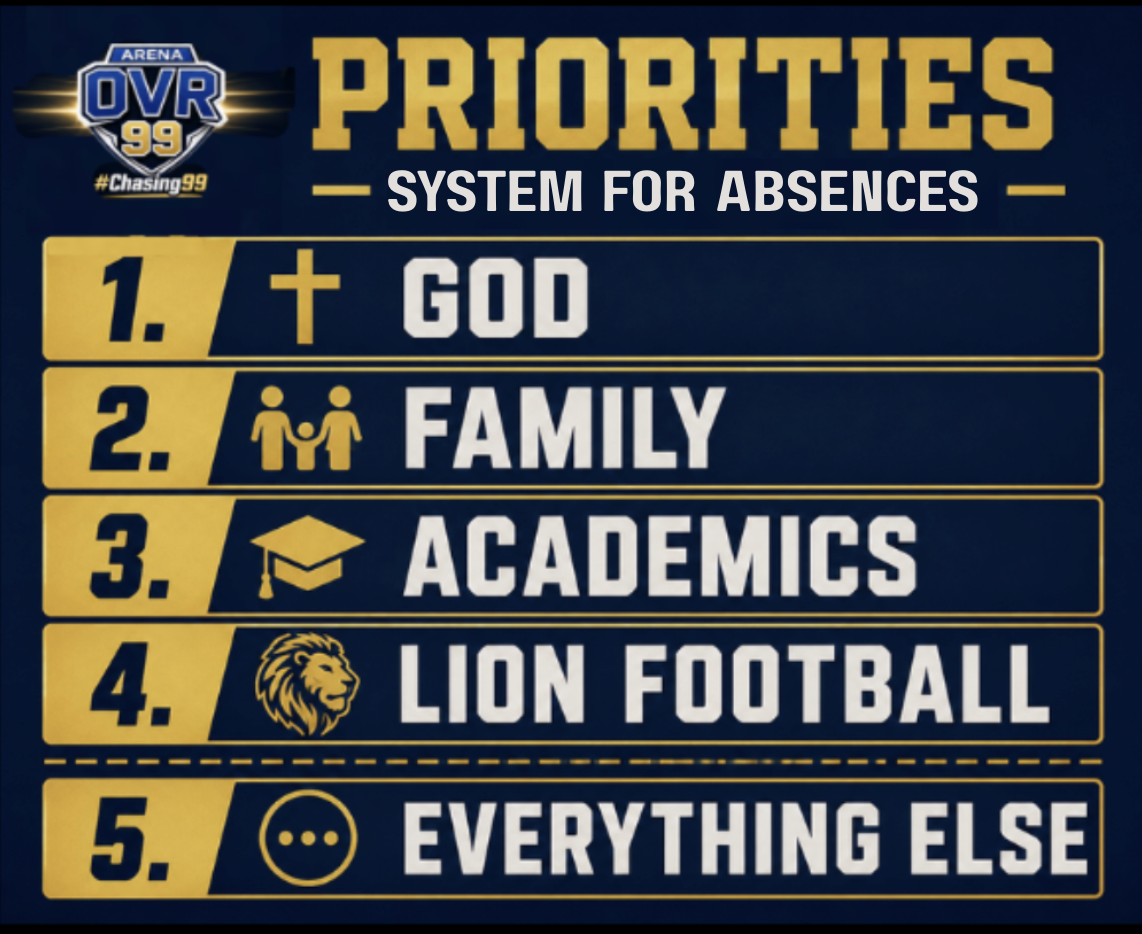
PRIORITIES
The idea is incredibly simple. Instead of the head coach deciding whether every absence is excused or unexcused, establish your program’s priorities before the season ever begins and make sure your players, parents and coaches understand them.
For example, your program’s priorities might look something like this:
Priority 1 — God
Faith comes first. Church services, youth activities, mission trips, and other meaningful faith commitments take priority over football.
Priority 2 — Family
A death in the family, serious family situation or something Mom and Dad truly need you for.
Priority 3 — Academics
Required tutoring, making up a test or a school obligation that cannot be moved. Academic contest, etc.
Priority 4 — Football
Practices, meetings, games, and team commitments. When you commit to the team, we expect you to be there.
--------------------------------------------
Priority 5 — Everything Else
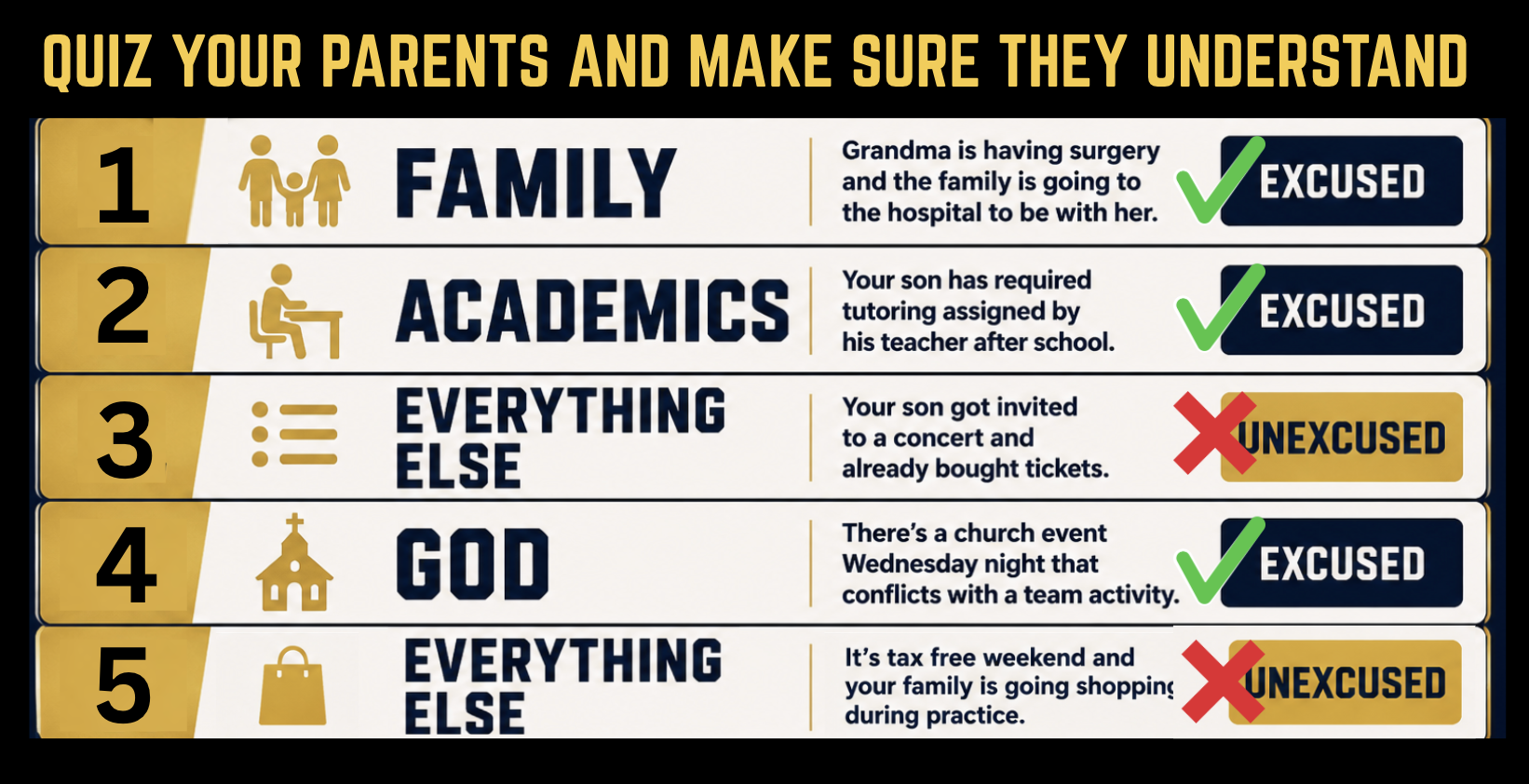
Now when a player misses practice, I don't have to decide whether his excuse is "good enough." I simply ask, "Which priority was it?"
Examples of Unexcused Absences (incorrect priorities :)
- Dentist appointment during practice.
- Haircut — only appointment available was during practice.
- Family vacation — leaving Friday instead of Saturday because it's cheaper.
- Work shift — player picked up a shift during practice.
- Didn't have a ride — player never contacted a coach or teammate to ask for help.
You know what I mean. We could have one heck of a group chat just sharing the unexcused excuses we've heard over the years! 😂
If something above football on our established priority list caused you to miss, we understand. If something below football caused you to miss, that's an unexcused absence.
No emotion. No arguing. No comparing Johnny's excuse to Billy's excuse from three weeks ago.
The system makes the decision.
The key is that your players and parents need to know the system before there's ever a problem. Teach it at your parent meeting, put it in your handbook and make sure every coach understands exactly how it works.
You don't create the rule after Johnny misses practice. When the situation happens, you don't have to invent an answer because you've already answered it.
There Must Be Consequences Either Way
There was an important distinction between excused and unexcused, but excused didn't mean there were no consequences. If you missed practice for an excused reason, you made up the conditioning you missed. If you missed a significant amount of practice, you also knew there was a possibility you wouldn't start the game.
An unexcused absence automatically meant double make-up conditioning and a loss of playing time. Our starting point was sitting the first quarter, with additional consequences for repeated absences.
That's the beauty of having the system. The player already knew the consequence before he ever missed practice. We weren't sitting in the coaches' office afterward trying to decide what was fair or what we had done with another player three weeks earlier.
The point wasn't to punish kids for having something important happen in their lives. The point was to make the expectations and consequences so clear that I didn't have to reinvent them every time somebody missed practice.
Here's what happened: we rarely had kids miss practice.
I don't think that was an accident. The players knew the priorities, the parents knew the priorities, and everyone knew there were consequences for missing. That's what a good system does. It doesn't just tell you what to do after a problem occurs—it helps keep the problem from occurring in the first place.
Protect Your Battery
Young head coaches sometimes think organization means having a great calendar, a sharp-looking handbook and a detailed practice schedule. Those things matter, but systems serve another incredibly important purpose.
You only have so much decision-making energy every day.
Don't waste it deciding what happens when somebody is five minutes late. Don't spend it deciding for the 37th time whether an absence should be excused.
Save your battery for the decisions that actually require the head coach—your personnel, your staff, your culture and the direction of your program.
This week, think about the problems you deal with over and over and ask yourself:
"Could I create a system so I never have to make this decision again?"
If the answer is yes, build the system.
Coach Bowden was right. If you're going to sit in the big chair, you're going to solve problems.
But that doesn't mean you have to solve the same problem over and over again.
P.S. Coach Jones sends out an outstanding email each week called Tiger Notes. It’s always full of great football and coaching information. If you’d like to get on his list, email Rick at rick.jones@missouri.edu and ask him to add you.