wednesday coach report: ‘state of the union’ first coaches’ meeting

Every July, about a week before fall camp began—and before we discussed offense, defense, or special teams—I gathered our staff for what I called our “State of the Union” meeting.
It usually lasted a couple of hours, and I spent days preparing for it.
Why?
Because I believed the first staff meeting of the season established the standard for everything that followed. It reminded us that coaching is a profession, not a hobby. It aligned our staff around a common purpose and reinforced the responsibility we shared—not just to win football games, but to shape the lives of young men.
The slides below come directly from those meetings.
Some are reminders. Some are expectations. Others are simply convictions that guided our staff every season.
As you prepare to meet with your own staff this week, I hope you find a few ideas here that you can use.
But there is one thing I made sure to do every year, and I strongly encourage you to do the same:
Speak from the heart.
Tell your coaches what truly matters to you. Share why you coach, what you believe your program should stand for, and the impact you expect your staff to have on young men.
Make it personal. That is what they will remember.
*My actual presentation had 53 slides but here are 12 I thought you might could use something from. I hope you can.
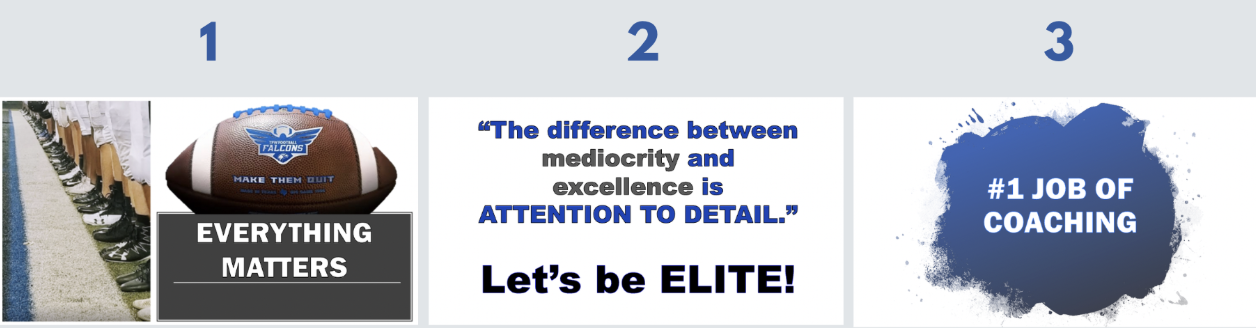
Slides 1 & 2: Everything Matters
The first two slides established one of the cornerstones of our program: we would be an Everything Matters program.
We would coach the little things because championships are built on attention to detail.
I wanted my staff to know that if I corrected one of their players during practice, it was never meant as criticism of the coach. It was simply our standard. If a player didn't sprint through the line or finish a drill the right way, I would coach that player immediately—without throwing the position coach under the bus.
Why? Because full speed is how we live. The little things eventually become the big things.
Slide 3: Our #1 Job
Before we talked about schemes or game plans, I wanted our staff to answer a more important question:
What does it really mean to be a coach?
Is it teaching football? Calling plays? Winning games?
Or is our first responsibility something much bigger than that?
For me, the answer was clear. The #1 job of coaching is to take a young man somewhere he could not have gone without you. Everything else flows from that purpose.
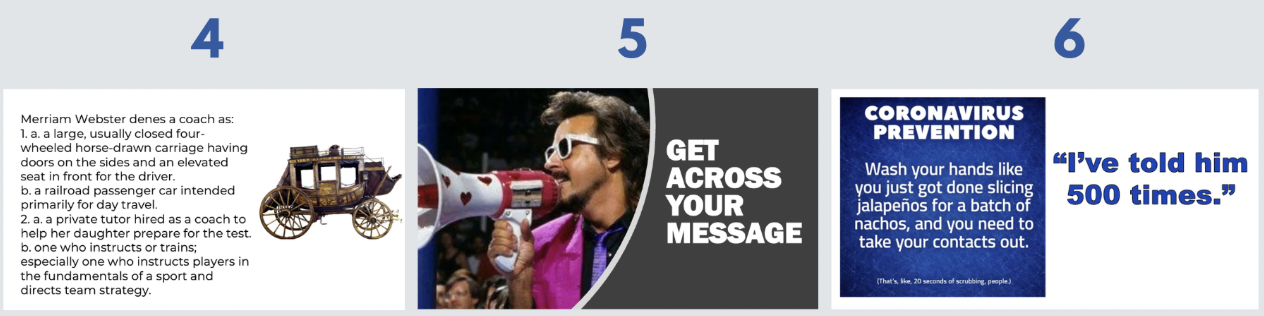
Slides 4-6: What Is Coaching?
Our job is to take young people where they could not—and would not—go without us.
The word coach originally referred to a stagecoach—a carriage hired to take people to a destination. Later, universities used the term for tutors because they "carried" students to academic success. Athletics simply adopted the same idea.
A coach takes people somewhere they cannot get on their own.
This season, we're here to do far more than teach football. We're here to help every player become a better athlete, teammate, and man.
How do we do that?
It's not their job to understand our message. It's our job to make sure they understand it.
Don't just tell them—check for understanding.
Ask questions. Quiz them. Have them explain it back to you. Demonstrate it. Show film. Tell a story. If one approach doesn't work, find another.
One of my biggest pet peeves is hearing a coach say, "I've told him 500 times."
No—you've said the same thing 500 times.
Our responsibility doesn't end when we speak. It ends when the player understands.
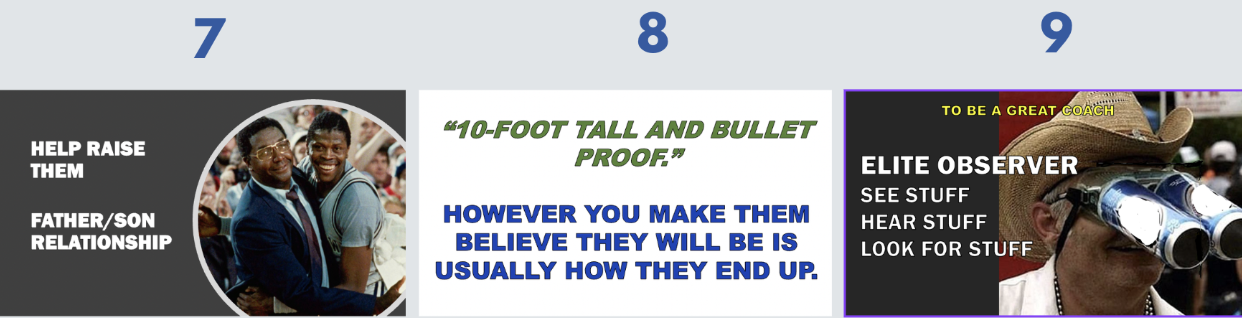
Slides 7–9: The Influence of a Coach
One of the greatest privileges in our profession is the platform we've been given.
During the season, we often spend more meaningful time with our players than anyone else—including their parents. That's an incredible responsibility, and we can't take it lightly.
This program will never be "win at all costs." Winning matters, but how we win matters even more.
Our players need to know two things every single day:
1. I love you.
2. I'm not lowering the standard.
Love them enough to put your arm around them after a tough day. Encourage them. Celebrate them. Let them know they matter.
But love them enough to coach them hard.
The best way I can describe it is family love—the kind of love that refuses to let someone settle for less than they're capable of becoming.
Hold them accountable. Demand excellence. Correct mistakes immediately.
Then, as soon as the lesson has been taught, get right back to family.
Our players should never question whether we care about them. They should only question whether they're living up to the standard we know they're capable of reaching.
8 –Fill Them with Confidence
One of our greatest responsibilities as coaches is to fill our players with confidence.
I've often said our job is to make them feel 10 feet tall and bulletproof.
Today's teenagers are growing up in a world filled with pressure, comparison, and anxiety. Many of them walk into our program doubting themselves long before they ever step onto the practice field.
How we consistently make them feel is often who they become.
That doesn't mean empty praise. It means helping players see the potential they can't yet see in themselves.
Correct them. Challenge them. Demand excellence.
But never leave them wondering if they're capable.
Every meeting, every drill, and every conversation should leave a player believing he's a little better than he thought he was an hour earlier.
Our words eventually become the voice they hear in their own heads.
Let's make sure it's saying:
"You can do this."
"You're ready."
"I believe in you."
Confident players play faster, recover from mistakes quicker, and are willing to attempt things fearful players never will.
If we can fill a young man with confidence, we've given him something that will serve him long after football is over.
9 - Be An ELITE OBSERVER
Great coaches don't just coach—they're ALWAYS WATCHING.
An elite coach is constantly watching, listening, and looking for opportunities to teach, encourage, or correct.
When you're on the practice field, in the weight room, in the locker room, or walking the hallways, be fully present. Put your phone away. Don't stand around talking with other coaches while life is happening all around you.
Watch body language.
Listen to conversations.
Notice who's unusually quiet. Notice who's leading. Notice who's drifting away from the team.
Some of the most valuable things you'll ever learn about a player happen when he doesn't realize you're paying attention.
Be where your feet are. The best coaches aren't just physically present—they're mentally present, too.
They see what others miss.
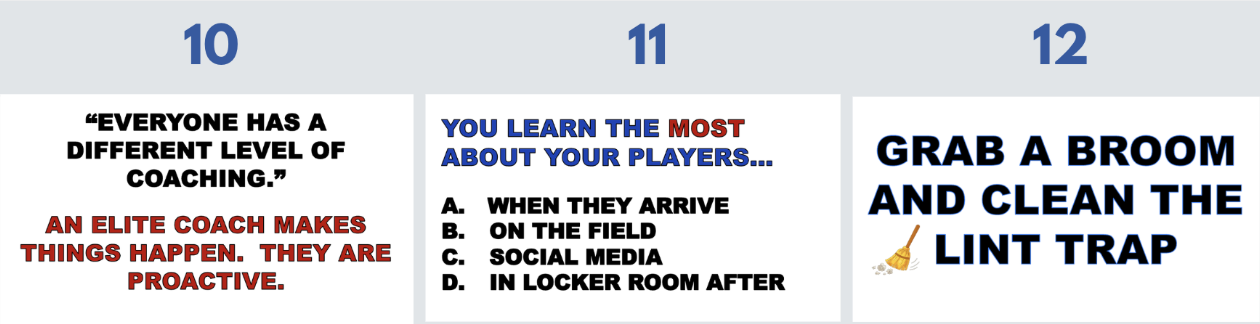
10 – Bring the Juice!
This next slide doesn't necessarily fit into a category—it was simply a standard I never wanted our staff to forget.
Years ago, I challenged one of my coaches to bring more enthusiasm to practice.
His response?
"Coach, everyone has a different level of coaching."
What??? It was all I could do not to start wrestling with him right then! :).
He didn't stay with us much longer after this.
We can't expect energy, passion, and enthusiasm from our players if they don't see it in us first.
You can't get what you don't have.
Be the most enthusiastic person in your drill.
Smile.
Coach with passion.
Make your players feel like coaching them is the best part of your day—not something you have to do, but something you get to do.
Energy is contagious.
If your drill lacks juice, don't look at the players first.
Look in the mirror.
Slide 11 – Know Your Players
The better you know a player, the better you'll coach him.
If all you know is his height, weight, and 40 time, you'll coach him one way. If you know what motivates him, what he's afraid of, what's happening at home, who his friends are, and what his dreams are, you'll coach him differently.
The more you know about a player, the easier it is to get your message across.
Where do you learn those things?
Sure, taking a player to lunch or sitting across from him at a pizza place is one of the best ways. But that can't happen every day.
One of my favorite times was after practice in the locker room.
The work is finished. The pressure is off. Their minds are relaxed.
Sit down.
Listen more than you talk.
Ask about family. Ask about school. Ask what they're doing that weekend.
Those five-minute conversations pay huge dividends when it's time to coach them hard.
Players don't care how much you know until they know how much you care.
When they know you care, they'll listen differently. And when they listen differently, your coaching has a chance to change their lives.
Slide 12 – Grab a Broom and Clean the Lint Trap
This slide actually came later in my presentation, but I wanted to include it because it says a lot about the kind of staff I wanted us to become.
One standard I constantly reminded our coaches of was this:
We don't go home when our job is finished. We go home when everyone's job is finished.
That starts with the head coach and coordinators. They have to set the standard.
An elite coach doesn't walk past something that needs to be done. He grabs a broom. He cleans the lint trap. He picks up trash. He straightens the locker room. He notices what others overlook because he's an elite observer.
The most disciplined teams usually have the most disciplined environments. If we expect our players to take pride in the locker room, equipment room, meeting rooms, and practice field, then we have to model that standard first.
Every day before we left, I'd tell the staff:
"Clean your desk area, and I'll see you tomorrow."
It wasn't really about the desks.
It was about establishing the habit of finishing well.
Every staff has a few pack mules who quietly carry the load, and a few who are always looking for someone else to do it.
Don't let that happen.
Talk about it. Expect it. Reward it.
Most importantly...
Live it.
Your staff will never consistently do what you preach. They will consistently do what you model.