wednesday coach report: relationship lunches
Summer Edition #1: Do You Know Them?
Coach,
Welcome to the first edition of The Wednesday Coach Report.
After 33 years of coaching, I've collected a lot of stories—some from my own teams, some from great coaches I've been fortunate enough to learn from, and some from conversations with coaches across the country.
Each Wednesday this summer, I'll share one practical idea that helped me build culture, improve accountability, strengthen relationships, or create a better team.
My goal isn't to give you one more thing to read.
My goal is to give you one idea you can implement tomorrow.
Everything I share will be written with one question in mind:
How can this help a coach build a better program?
Summer is one of the few times of the year when coaches have an opportunity to truly get to know their players.
Don't waste it.
Every coach wants a team where players trust each other. We want connection. We want a locker room where athletes genuinely care about the guy standing next to them.
We want a team where players would "lay in traffic" for one another.
But that kind of culture doesn't happen because we put a slogan on a t-shirt or hang a poster on the wall.
It happens when people know each other.
How many of your players know your story?
How many know why you coach?
How many know about the people, experiences, failures, and lessons that shaped you?
Now flip the question.
How many of your players have told you their story?
How many know what a teammate is dealing with at home?
What he's proud of?
What he hopes to become someday?
Relationships create trust. Trust creates connection. Connection creates culture.
One of the best things we ever did during the summer had nothing to do with football.
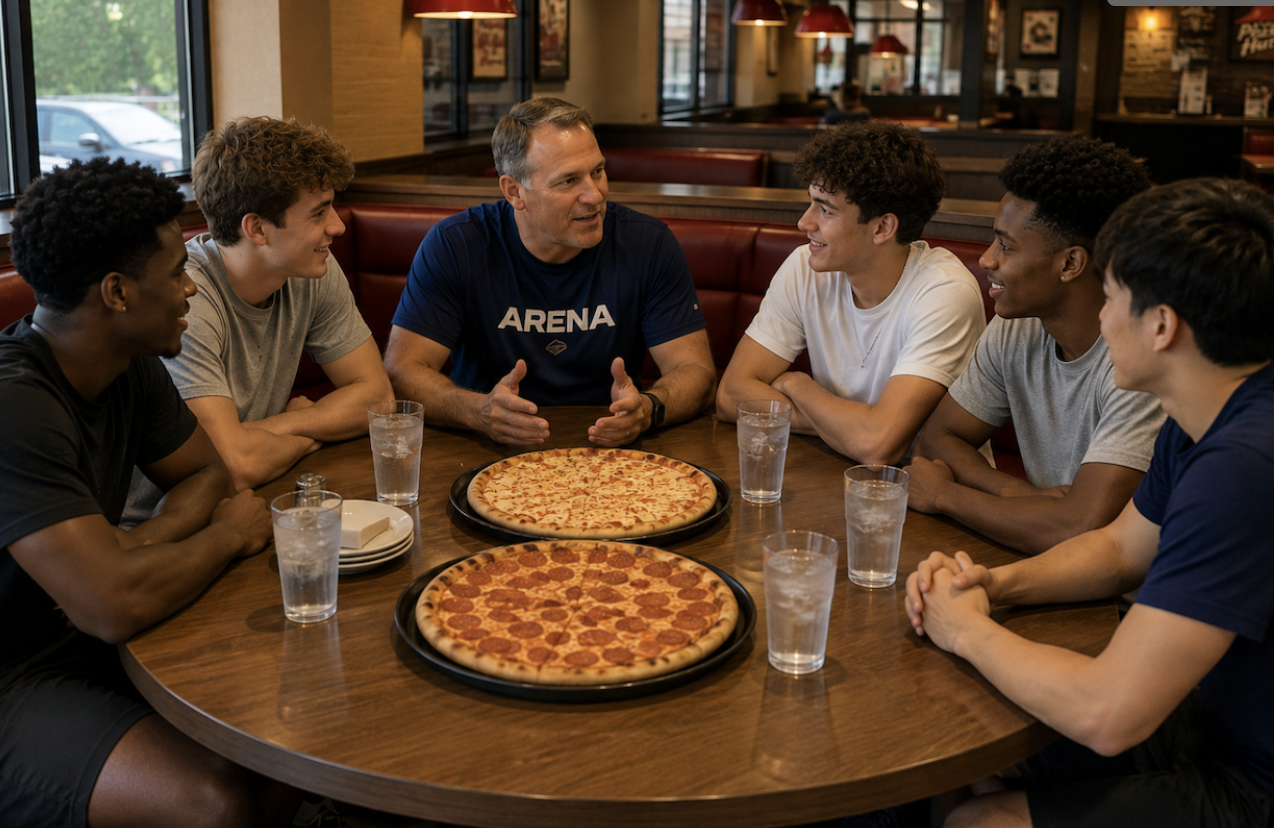
Every Wednesday, I would invite six or seven athletes and one assistant coach to lunch. Usually it was pizza, and one thing that made it work was that the groups were mostly random.
I wasn't just taking captains, starters, or the kids who were easiest to talk to. In fact, I intentionally mixed seniors with freshmen, linemen with receivers, starters with backups, and outgoing personalities with quieter kids.
I wasn't looking for my leaders. I wasn't looking for my best players. I was looking for relationships.
The more random the group, the better. Some of the best conversations happened when a senior sat next to a freshman he barely knew or when a receiver learned something about an offensive lineman he'd never really talked to before.
The goal wasn't football. The goal was relationships.
We'd sit around a table, eat pizza, and talk about life. Before long, players were learning things about teammates they never would have discovered during practice, and coaches were learning things about players they never would have learned from a workout sheet or depth chart.
Some of the best conversations happened when a senior sat next to a freshman he barely knew or when a receiver learned something about an offensive lineman he'd never really talked to before.
The goal wasn't football.
The goal was relationships.
We'd sit around a table and talk.
Questions like:
• What's your favorite movie of all time?
• If you could instantly master one skill, what would it be?
• What's something you're proud of that most people don't know?
• Who has had the biggest influence on your life?
• What job do you think you'll have when you're 30?
At first, the answers were short. Most athletes weren't used to sitting around a table with coaches and teammates talking about anything other than sports.
But after a few questions, the stories started to come out.
Players learned things about teammates they had never known. Coaches learned things about players they never would have discovered during practice. The quarterback learned something about the freshman offensive lineman. The senior linebacker learned something about the backup receiver. The quiet kid who rarely said much suddenly had a story that everyone remembered.
One lunch at a time, relationships started to grow.
Looking back, those Wednesday lunches probably did more for our culture than many of the football activities we spent hours planning. They helped players see each other as people, not just positions on a depth chart.
And when players know each other's stories, they're far more likely to care about each other when adversity hits.
COACH'S CHALLENGE
Don't make this a one-time event.
Make it a summer habit.
Every week during summer workouts, take 5-7 athletes to lunch. Bring an assistant coach. Ask a few questions. Listen more than you talk.
By the end of the summer, you'll have spent meaningful time with 30-40 athletes and learned more about your team than you ever could from a workout sheet or depth chart.
Relationships create trust.
Trust creates connection.
Connection creates culture.
The strongest teams aren't always the teams that know the playbook best.
They're often the teams that know each other best.
P.S. If there's a coaching, culture, leadership, attendance, accountability, parent, or team-building topic you'd like me to discuss, simply reply to this email. If enough coaches are wrestling with the same challenge, I'll address it in a future Wednesday Coach Report.