A great coach admitted this to me yesterday…

I had a conversation this week with a head coach I really respect.
He’s one of the best relationship-builders I know.
Players love being around him.
They feel valued.
Practice is often the best part of their day.
You know the type of coach I’m talking about.
The kind players remember years later. Someone you'd want your son to play for.
But during the conversation he told me something that caught me off guard.
He said,
“You know what I’ve never done before?
I’ve never had a leadership council.”
No captains meetings.
No small leadership group.
No structured way for players to lead players.
Just him leading the team. And honestly, that’s not unusual.
A lot of really good coaches do the same thing.
They build great relationships.
They pour into their players.
But leadership inside the team still runs through one voice.
The head coach.
Here’s the challenge with that.
Players respect coaches, but they follow teammates.
The real conversations in a locker room don’t happen when the coach is talking.
They happen:
• in the locker room
• on the bus
• during workouts
• when the coach isn’t there
And if you don’t have a group of players shaping those conversations, the culture of the team is basically left to chance.
The best programs I’ve seen all do something intentional.
They build a small group of leaders and spend time with them.
Not to give them titles.
But to help them understand things like:
- How to confront a teammate
- How to pull a struggling player along
- How to respond after a loss
- How to raise the standard in practice
Because most captains are good kids…
But nobody has ever actually taught them how to lead.
It’s something I’ve been thinking a lot about lately.
Leadership on a team shouldn’t be accidental.
It should be trained.
Let me leave you with a question that might be worth asking yourself as a coach:
If you weren’t in the building tomorrow, who would lead your team?
Not who has the title. Who would actually lead?
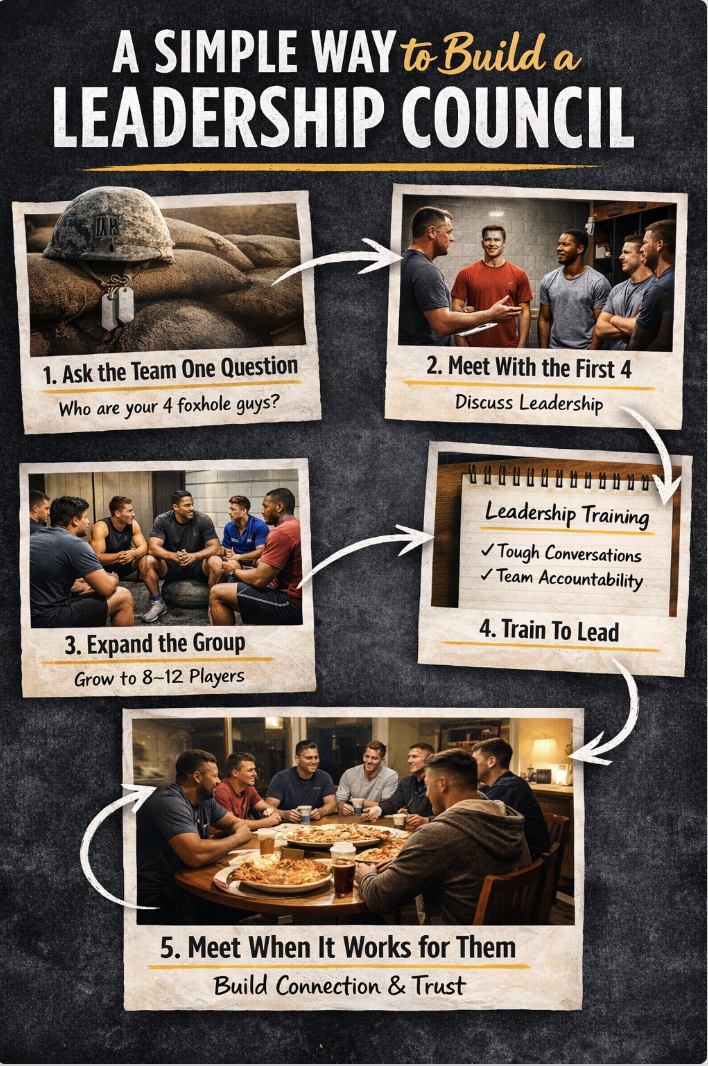
A Simple Way to Start a Leadership Council
If you’ve ever thought about creating a leadership council but weren’t sure where to start, here’s a simple system that works.
Step 1 — Ask the Team One Question
Send your team a short Google Form and ask one question:
“If our town was attacked and you had to go into a foxhole, which four teammates would you want beside you?”
This question reveals something important.
Players usually don’t choose the most popular teammate.
They choose the player they trust.
The one who shows up.
The one who stays calm.
The one who has their back.
When the responses come in, you’ll likely see the same names appear over and over.
Those are your first leaders.
Step 2 — Meet With Those Four
Bring those four players together and explain that you need their help.
Tell them you want to develop stronger leadership within the team and that leadership is something you’re going to train intentionally, just like you train strength, technique, and position skills.
Leadership is not something players automatically know how to do.
It’s something they learn.
Step 3 — Let Them Build the Group
Ask those four players a simple question:
“Who else needs to be in this room with us?”
Have each of them invite someone they respect.
Now the group grows to 8–12 players.
At this point something important has happened.
Every player in the room has either been nominated by the team or invited by a leader.
That creates immediate credibility inside the locker room.
Step 4 — Meet Regularly and Train Leadership
Meet once a week or twice a month for about 30 minutes.
Have a simple leadership curriculum or topic ready for each meeting so the conversation stays focused.
Treat it the same way you would a position meeting.
Leadership is a skill, so these meetings should train it intentionally.
Talk through real situations players face, like:
• A teammate giving poor effort in practice
• The sideline losing energy during a game
• A player struggling with confidence
• Holding a teammate accountable the right way
When players regularly discuss situations like these, they begin to understand that leadership is something that can be practiced and improved.
Step 5 — Meet When It Works for Them
One mistake coaches sometimes make is scheduling leadership meetings at the worst possible time.
If the meeting is at 6:00 AM, players won’t look forward to it.
Find a time that works for them.
One idea that works really well is hosting the first meeting at your home and feeding them.
Sitting around a table together breaks down barriers and builds connection quickly.
Players start to see you not just as their coach, but as someone who genuinely cares about them.
That kind of setting can strengthen your connection with those leaders tenfold.
When players enjoy the meeting and feel like their voice matters, they engage more and the leadership group becomes something they actually care about.
Closing Thought
Every team has leaders.
The question is whether those leaders are developed intentionally or accidentally.
Because the strongest teams aren’t coach-led.
They’re player-led.
Question for you
Do you currently use a leadership council with your team?
Reply and let me know. I’d love to hear how you approach it.
— Coach Jackson