Is Being With Your Team the Best Part of Their Day?
From time to time, I’m invited into athletic programs to do a program audit.
Not a report card.
Not a “gotcha.”
It is an honest look at the daily experience of the athletes and how can I help make it a more special experience.
The goal is simple: step into their world, see what it feels like to be part of the program, and identify small, practical ways to make it better.
What follows is a walk through Day 1 of a recent audit.
Day 1: The Experience
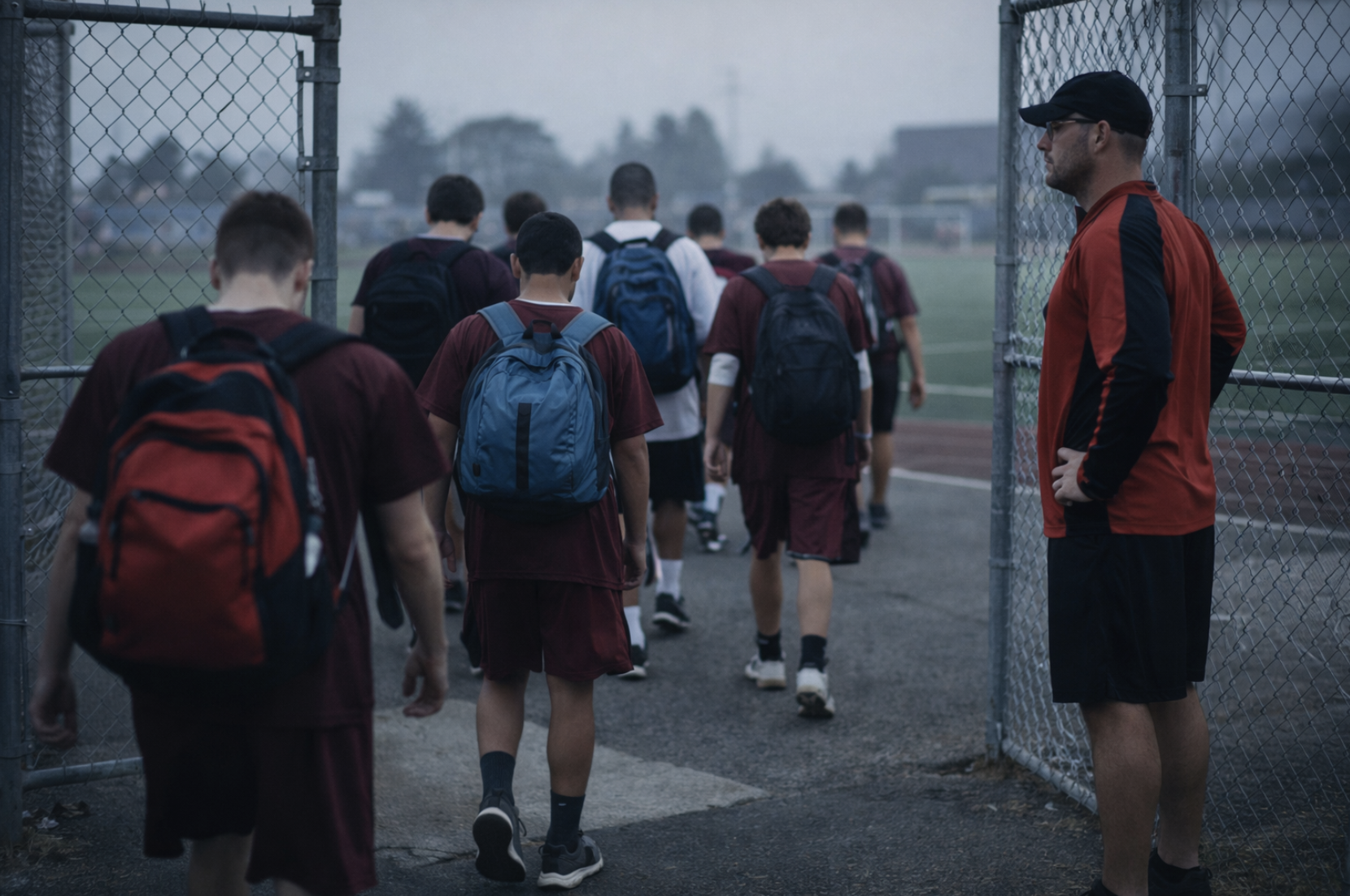
The bell rings.
Players start walking toward the field house.
Some are talking.
Some have headphones in.
Most are just moving from one class to the next.
At the gate, there’s one coach standing there.
No music.
No greetings.
No high-fives.
No juice.
He’s not doing anything wrong.
He’s just standing there.
There are other coaches around.
They’re nearby.
They’re present.
They’re already thinking ahead—focused on the workout, the timing, the plan that’s about to start.
Their attention is on what’s coming next,
not on what’s happening right now.
No one owns the entrance.
No one sets the tone.
Again—nothing is wrong.
But nothing is being done on purpose yet.
This is Day 1 of a program audit.
And this is where the real work begins.
Arrival: Compliance Isn’t the Goal
Let’s be clear about what this is not.
The athletes aren’t cursing.
They aren’t being disrespectful.
They aren’t dragging their feet.
They’re moving at a decent pace.
They’re doing what’s asked.
They’re compliant.
For a lot of programs, that’s considered a win. But compliance will never be the standard.We don’t want this to be a good workout.
We want it to be the best workout any team in the state has today.
The kind of workout that shows up later—
when an athlete who usually says very little looks up at the dinner table and says,
“We had an awesome workout today.”
Not because of the exercises.
Not because of the volume.
Not because of what’s written on the plan.
Because of the experience.
Right now, the experience feels neutral.
Functional
Efficient
Forgettable
No Launch. No Framing. No Why.
The players get dressed and head straight to the track.
There’s no launch meeting.
No gathering point.
No word from the head coach.
No framing of the day.
No reminder of standards.
No statement of purpose.
Again—nothing is wrong here.
But something important is missing.
All programs should have a minimum five-minute team meeting before work begins.
Five minutes to:
Reinforce the culture
Remind athletes what the program stands for
Celebrate the ones doing it the right way
Because what you talk about daily, you create.
Without that moment, there’s nothing that tells the athletes this time is different from every other period of their day.
No signal that says:
This matters.
You matter.
This time is intentional.
And when that signal is missing, the workout may still get done—
but the opportunity to shape culture quietly slips by.
Warm-Up: everything Matters
The warm-up is organized.
But it isn’t intentional.
And that distinction matters.
The warm-up is the front porch of the workout.
It tells everyone—athletes and coaches alike—what kind of standard is expected today.
Here’s one example.
Athletes were instructed to clap when each group began a drill.
Most didn’t.
Occasionally, a reminder was given.
But there was no correction.
No reset.
No insistence that it be done right.
So the message was clear—even if unintentional:
Details are optional right now.
The athletes weren’t being disrespectful.
They weren’t cutting corners.
They were responding to the environment.
No one was making attention to detail matter.
And athletes always rise—or fall—to the level of what’s enforced.
Coaches were around.
The plan was moving.
Time was being filled.
But the standard wasn’t being protected.
When the warm-up lacks precision, it quietly gives permission for the rest of the workout to drift toward survival mode.
Not because the athletes don’t care—
but because no one is demanding excellence yet.
If the front porch is sloppy, the house never feels right.
Best-in-the-state workouts don’t start when the clock says work.
They start the moment athletes arrive—and that same energy should carry straight into the warm-up.
Warm-up is where details are stressed, but they’re stressed with juice and encouragement.
When I was coaching, I always assigned my staff a specific line or group during warm-ups. That wasn’t accidental.
Warm-up was our chance to connect, coach details, and make that interaction the best part of their day before the hard work ever began.
The Workout: Hard Work Was Never the Issue
The workout starts.
The players run hard.
It’s structured.
It’s demanding.
It’s organized.
No one is loafing.
No one is cutting corners.
This matters, so it needs to be said plainly:
This is not a lazy program.
The athletes are working.
They’re doing exactly what’s asked.
But effort alone doesn’t make this the best part of their day.
The real question is simpler—and harder:
Do they feel special being here?
Near the end of the workout, I stop the group and tell them this:
“I’ve been part of workouts like this a hundreds or thousands of times, and I’m impressed with how hard you’re working.
But right now, you’re in survival mode. Everyone is just trying to get through it.
No one is encouraging the person next to them.
No one is lifting the group.Right now, this doesn’t feel like a team working together—it feels like a bunch of individuals sharing the same track.”
That’s the difference. Coaches must train athletes to encourage each other.
Hard work can exist without connection.
Effort can exist without energy.
When that happens, the workout gets done—but the moment doesn’t linger.
Functional vs. Exceptional
Right now, this environment works.
But best-in-the-state environments don’t just work.
They feel different.
Not louder.
Not crazier.
More intentional.
This is the gap most programs don’t see.
Nothing is going wrong…
but nothing is being done on purpose to elevate the experience.
Average days, stacked together, quietly define culture.
What’s Missing Isn’t Complicated
This isn’t about changing the workout.
It’s about what surrounds it.
Three things are missing—and all three are fixable.
1. People
No one is bringing the juice, high-fiving or fist-bumping.
2. Improvement
There’s work, but no feedback loop.
No visible proof that today moved them forward.
3. Celebration
Effort goes unnoticed.
Details go unrecognized.
Standards go unrewarded.
Every program celebrates something.
Silence celebrates nothing.
A Question for You, Coach
As you read this, here’s the question to sit with:
How does this stack up to your workouts?
Not compared to your best day.
Not compared to playoff week.
Compared to a normal one - Tuesday, January 20th.
If I stood at the entrance of your field house tomorrow,
what would it feel like?
And let’s remove an easy excuse.
Even if your workout starts at 6:00 a.m., the entrance should still look the same.
High-fives.
Music.
Eye contact.
Energy.
Not because it’s loud.
Because it says something without words:
We notice you.
We’re glad you’re here.
We get to coach you today.
Early mornings don’t lower the standard.
They raise it.
Before Part 2 - a free resource
Before you think about fixing anything, listen.
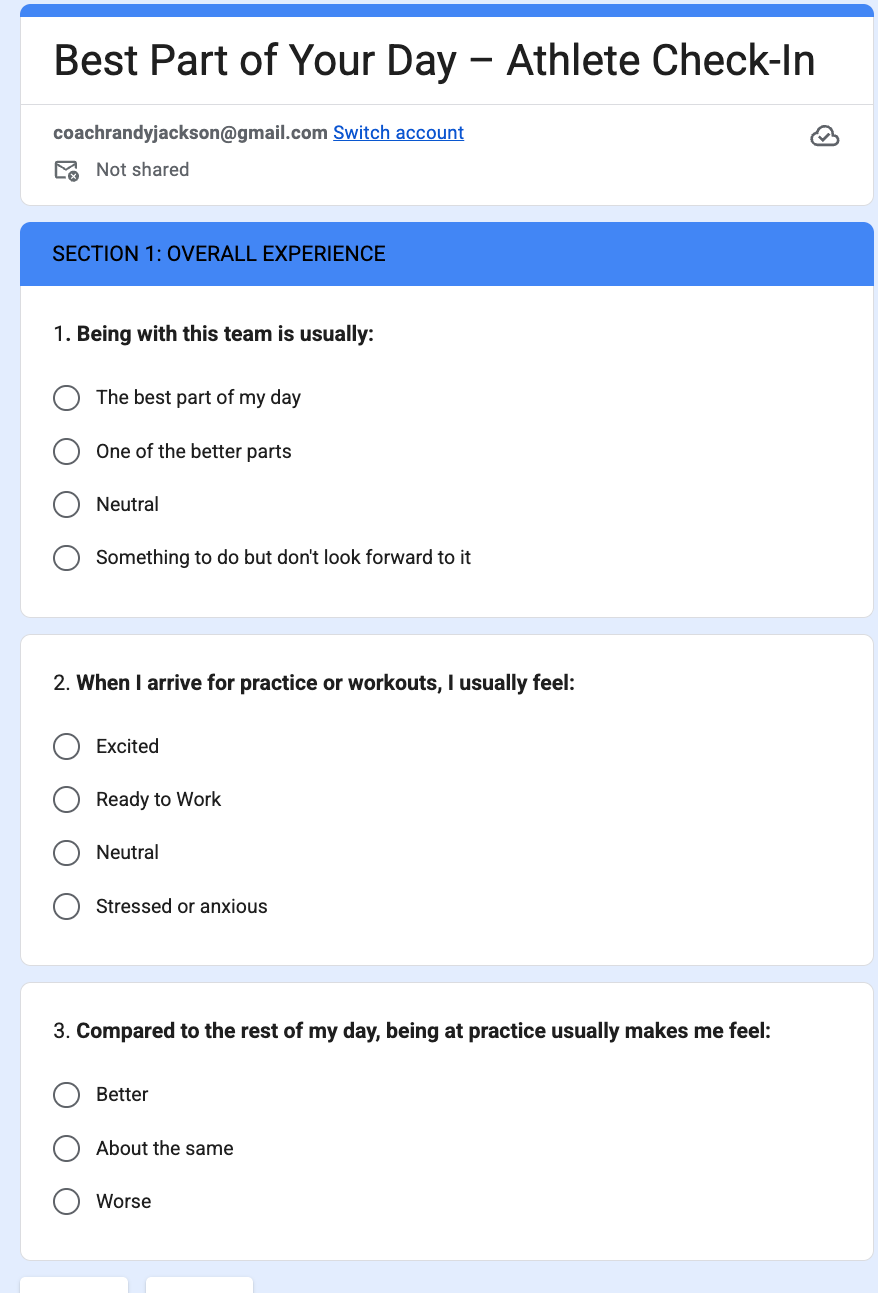
During this audit, I created a short, anonymous Google Form and sent it directly to the athletes.
Not to explain decisions.
Not to justify systems.
Not to defend anything.
Just to understand what it feels like to be part of the program.
You should do the same—today.
This will be great feedback for you and they will feel heard.
Click the link below.
Google will prompt you to make your own copy of the form.
Send it to your athletes.
That’s it.
No meeting.
No speeches.
No names attached.
Just honest feedback.
👉 Here’s the form: SEND
Send this to your team today (5 minutes to respond)
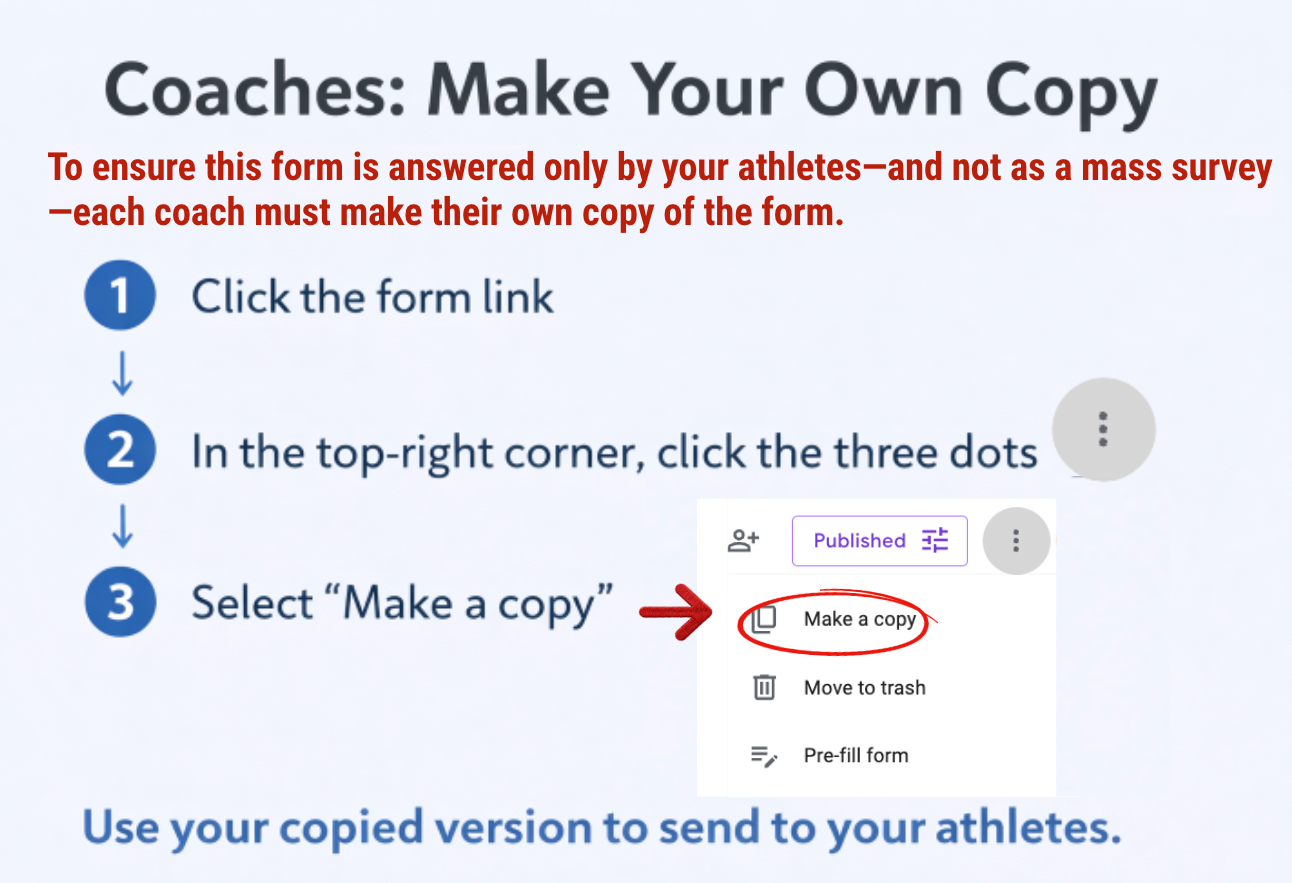
*Important — read this before sending it to players:
To ensure this form is answered only by your athletes—and not as a mass survey—each coach MUST MAKE A COPY OF THEIR OWN FORM.
It takes less than 30 seconds.
Here’s how to do it:
Click the link above
In the top-right corner, click the three dots (⋮)
Select “Make a copy”
Use your copied version to send to your athletes
If you want your athletes to feel special when they’re with the team, the first step is understanding what it currently feels like to be one of them.